


Disclaimer
This post may contain affiliate links. I will make a small commission if you make a purchase through one of these links, at no extra cost to you. See full disclosure and disclaimer policy HERE.
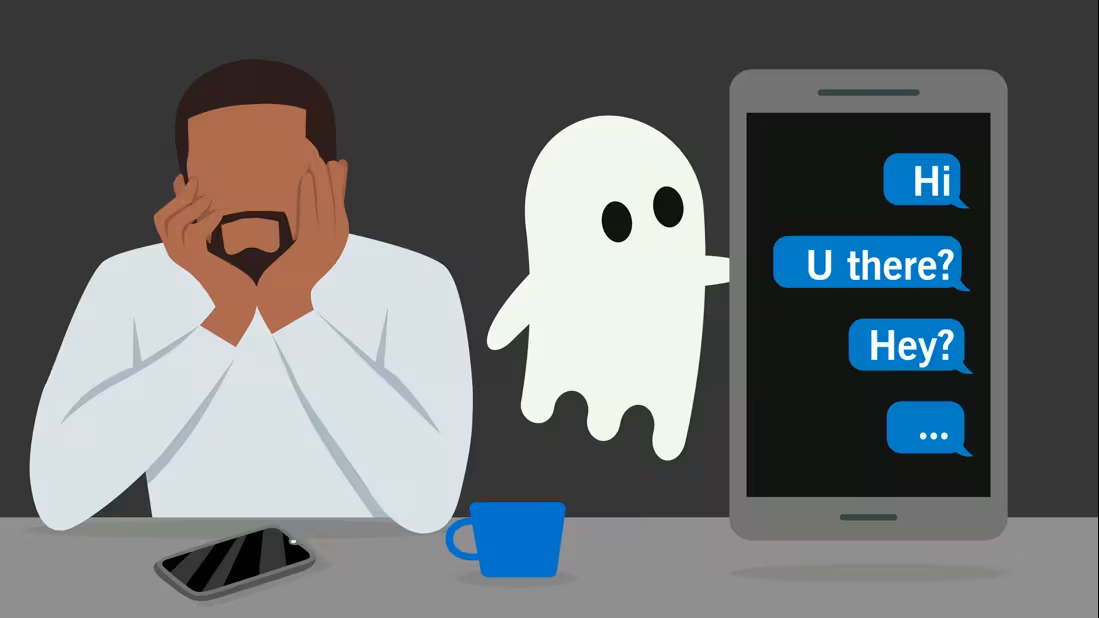
One minute, you’re exchanging messages until midnight, flirting over drinks, making plans, perhaps sharing a bed. The next? Silence.
Your last message sits there like a tiny digital crime scene.
Delivered. Maybe read. Definitely unanswered.
So you wait. Perhaps they’re busy. Perhaps something happened. Perhaps they’ll reply tomorrow. Then tomorrow becomes three days, three days become a week, and eventually you find yourself staring at their Instagram story wondering how someone apparently too overwhelmed to type “Hey, I don’t think this is going anywhere” managed to photograph their brunch from four different angles.
Welcome to ghosting: one of modern dating’s most frustrating disappearing acts.
Researchers generally describe ghosting as ending a relationship or interpersonal connection by stopping communication without explaining why. But that clinical definition doesn’t quite capture the experience of it.
Ghosting isn’t simply rejection. It’s rejection with a question mark attached.
And that question mark is precisely why it can get under your skin.
What Counts as Ghosting, Anyway?
Not every delayed reply is ghosting.
Someone taking two days to answer isn’t necessarily ghosting you. Neither is a person you’ve exchanged three messages with on Tinder before the conversation quietly dies. People get busy. Conversations fizzle. Interest changes.
Ghosting becomes more meaningful when there has been an established pattern of mutual communication and one person unilaterally stops participating without explanation. Recent academic work particularly emphasizes meaningful prior two-way communication, an unexplained cessation of contact, and the apparent intention to end the connection.
There’s also a difference between ghosting and its irritating cousins.
Slow fading is gradually becoming less available until the relationship suffocates from lack of oxygen.
Breadcrumbing is giving someone just enough attention to keep them interested without actually progressing the relationship.
Orbiting is disappearing from direct communication while continuing to hover around someone’s digital life—watching stories, liking posts, perhaps occasionally reacting to something without initiating a genuine conversation.
Ghosting is simpler. You were talking. Then one person disappeared.
Why Does Ghosting Hurt So Much?
Because your brain likes completed stories.
Imagine watching a murder mystery for ninety minutes and having the television switch off immediately before the detective reveals the killer.
You’d probably want to throw something.
Ghosting creates a similar psychological irritation, except the mystery is personal.
Did I say something wrong?
Did they meet someone else?
Were they never interested?
Did I come on too strongly?
Are they frightened of intimacy?
Are they going to come back?
Direct rejection gives you information. Ghosting gives you ambiguity.
Research comparing ambiguous and direct rejection has found ghosting can generate particularly negative emotional reactions. The absence of explanation leaves your mind with an unfinished puzzle, and unfortunately, the human brain is remarkably willing to manufacture missing pieces.
Usually at 2:17 a.m. And rarely in your favour.
So Why Do People Ghost?
Here’s where things become more complicated.
We often talk about ghosters as though they’re a single species: emotionally unavailable creatures roaming dating apps and feeding exclusively on other people’s self-esteem.
Reality is considerably messier.
Research suggests people ghost for multiple reasons, including convenience, discomfort with confrontation, beliefs that ghosting is acceptable in certain digital dating situations, communication overload, and sometimes legitimate concerns about safety.
In other words, the behaviour may look identical from your side of the screen while having very different motivations behind it.
They Lost Interest and Didn’t Want the Awkward Conversation
This is probably the least mysterious explanation.
They liked you. Then they didn’t like you enough.
And instead of communicating that change, they disappeared.
Why? Because rejecting another person is uncomfortable.
You might have to disappoint them. They might ask why. They might become upset. You might feel guilty.
Ghosting provides an emergency exit.
No conversation. No tears. No uncomfortable explanation. Just poof.
This doesn’t necessarily mean the ghoster is malicious. It may simply mean they prioritise avoiding their own discomfort over giving another person clarity.
That’s still useful information about them.
They Avoid Conflict
Some people experience interpersonal conflict as something to resolve.
Others experience it as something to escape.
If someone has difficulty saying no, expressing uncomfortable emotions, establishing boundaries or tolerating another person’s disappointment, disappearing can feel easier than communicating.
Consider the difference between:
“I’ve enjoyed spending time with you, but I don’t feel the connection I’m looking for.”
and…
Nothing.
The second requires considerably less courage.
Ghosting can therefore function as an avoidance strategy: instead of managing an uncomfortable interaction, the person removes themselves from it entirely. Researchers commonly describe ghosting as an avoidance or withdrawal-based rejection strategy.
They Feel Overwhelmed
Sometimes ghosting isn’t particularly personal.
Digital dating gives us unprecedented access to other people.
Unfortunately, it also gives other people unprecedented access to us.
Messages. Matches. WhatsApp. Instagram. Dating apps. Notifications.
One study of emerging adults found that communication overload predicted ghosting romantic partners.
Someone juggling multiple conversations may simply begin withdrawing from them.
That doesn’t make disappearing considerate.
But it does challenge one particularly seductive assumption:
They disappeared because I did something wrong.
Maybe.
But perhaps they were simply exhausted by their own digital life.
CHECK THIS OUT:
Why Modern Dating Feels So Emotionally Exhausting
Sometimes They Ghost Because Things Became Too Intense
Here’s an interesting possibility.
People don’t exclusively disappear when they feel nothing.
Occasionally, people withdraw precisely because a connection has started requiring more emotional engagement than they’re prepared to give.
Casual flirting is easy. Sex can even be easy.
Vulnerability? Different animal entirely.
Suddenly there are expectations. Feelings. Questions. Decisions.
What are we doing? Where is this going?
Someone comfortable with attraction but uncomfortable with emotional responsibility may retreat when the relationship crosses an invisible threshold.
This is where people sometimes mistakenly conclude:
“They ghosted because their feelings were too strong.”
Careful. It’s possible someone felt something and became uncomfortable.
But ghosting itself doesn’t prove deep feelings.
Silence is not a secret love letter.
Without additional evidence, all you actually know is that they stopped communicating.
They Wanted Something Casual—and Got What They Wanted
Sometimes the explanation is painfully uncomplicated.
They wanted attention. Validation. Flirtation. Sex. Entertainment. An ego boost. A distraction after their breakup.
Then the experience served its purpose.
Research has found ghosting tends to be viewed as more acceptable in short-term than long-term romantic contexts, particularly among people who have ghosted before.
That doesn’t mean everyone seeking casual sex is destined to vanish before breakfast. Plenty of people enjoy casual relationships while communicating perfectly well.
But low-investment relationships can make disappearing psychologically easier.
If someone never intended to build anything, they may not feel obligated to formally dismantle it.
They Think Ghosting Is Kinder
This sounds absurd when you’re on the receiving end, but some ghosters genuinely believe silence is less hurtful than explicit rejection.
And there’s fascinating research behind this.
Experimental research published in 2024 found that people who ghost may actually care more about the ghosted person’s wellbeing than the recipient assumes.
Think about the strange logic:
“I don’t want to hurt them by telling them I’m not interested.”
So instead, they disappear.
Unfortunately, avoiding the rejection doesn’t eliminate it.
It merely forces the other person to discover it gradually.
It’s like refusing to remove a plaster because you’re worried the patient might say ouch.
They Were Afraid of Your Reaction
There are circumstances where ghosting isn’t merely understandable—it may be sensible.
If someone has behaved aggressively, ignored boundaries, become controlling, harassed the other person or created genuine concerns about safety, nobody owes them an elegant breakup speech.
Safety changes the rules.
Research on ghosting motivations specifically includes safety concerns among the reasons people sometimes choose this form of disengagement.
Sometimes disappearing isn’t cowardice.
It’s protection.
Does Ghosting Mean They Never Cared?
Not necessarily.
This may be the hardest misconception to shake.
Someone can enjoy you and still ghost you.
Someone can desire you and ghost you.
Someone can care about you and ghost you.
Someone can miss you afterward and still not contact you.
Human beings are frustratingly capable of holding contradictory feelings simultaneously.
Research into ghosters’ experiences has found that the person disappearing may experience emotions of their own, including guilt and relief.
So don’t rewrite an entire relationship simply because of its ending.
If someone seemed attracted to you, they probably were.
If you shared genuinely intimate moments, they may have experienced them as genuinely intimate too.
Their later withdrawal doesn’t automatically make everything before it fraudulent.
But—and this matters—having feelings for someone and being capable of sustaining a relationship with them are completely different things.
Chemistry isn’t communication.
Desire isn’t reliability.
Affection isn’t commitment.
And missing someone isn’t the same thing as showing up.
Does Ghosting Mean They’re Emotionally Unavailable?
Maybe.
But resist turning attachment theory into forensic science.
Social media has created an irresistible habit of diagnosing romantic disappointments:
Ghosted? Avoidant attachment.
Love-bombed? Narcissist.
Didn’t text back? Childhood trauma.
Sometimes these explanations contain truth. Attachment patterns and beliefs about relationships have indeed been associated with ghosting behaviours and experiences.
But you cannot diagnose someone’s entire emotional architecture from three unanswered WhatsApp messages.
What you can conclude is simpler:
At that moment, that person wasn’t willing or able to communicate with you directly.
That’s enough information to make decisions.
What Ghosting Actually Says About You
This is where ghosting becomes dangerous.
Because when someone refuses to provide an explanation, we often volunteer one ourselves.

And we’re remarkably cruel scriptwriters.
I wasn’t attractive enough.
The sex wasn’t good.
I talked too much.
I wasn’t interesting enough.
I shouldn’t have sent that message.
I shouldn’t have slept with them so quickly.
I should have been less available.
Maybe you made mistakes. Everyone does.
But ghosting itself cannot tell you which mistakes you made—or whether you made any at all.
That’s the trap.
You’re trying to extract information from an event that contains very little information.
Ghosting primarily tells you something about their decision to disengage, not your objective desirability.
What If They Keep Watching Your Stories?
Ah.The modern romantic séance.
They haven’t messaged you in three weeks, but somehow they’re watching your Instagram story fourteen seconds after you post it.
Surely that means something?
Possibly. But probably not as much as you’d like.
People watch stories because they’re curious. Because they’re bored. Because they miss someone. Because Instagram automatically feeds them the content. Because they want to see whether you’ve moved on. Because they’re attracted to you. Because they’re procrastinating while sitting on the toilet.
Digital attention is cheap. Direct communication requires intention.
So if someone ghosts you but continues hovering around your social media, don’t confuse visibility with effort.
A story view is not a conversation.

The Psychology of Desire: Why We Want What We Want
THE EVOLUTION OF DESIRE IN THE DIGITAL AGE

HOW TO TALK TO A PARTNER ABOUT TRYING SOMETHING NEW IN BED
Do Ghosters Ever Come Back?
Of course.
Ghosts have a notorious tendency to become corporeal again.
Three weeks later:
“Hey stranger 😉”
Two months later:
“Randomly thought about you today.”
Six months later:
“How have you been?”
Suddenly Lazarus has Wi-Fi.
Why do they return?
Sometimes they miss you. Sometimes they’re lonely. Sometimes another relationship ended. Sometimes they’re horny. Sometimes nostalgia kicked in. Sometimes they’re testing whether they still have access to you.
And sometimes they genuinely regret how they behaved.
The return itself tells you very little.
What happens after the return tells you considerably more.
Do they acknowledge disappearing?
Do they apologise?
Do they explain what happened?
Has their behaviour changed?
Are they actually offering something different?
Or are they simply knocking on a door they remember being unlocked?
Should You Ask a Ghoster Why They Disappeared?
You can.
There’s nothing inherently undignified about asking someone for clarity.
A simple message such as “I noticed you’ve gone quiet. If you’re no longer interested, that’s completely fine—I’d just prefer clarity” is perfectly reasonable.
What becomes painful is repeatedly requesting an answer from someone who has already demonstrated that they don’t intend to provide one.
At some point, silence becomes information.
Not information about why they disappeared.
Information about how they handle relationships when things become uncomfortable.
And that may ultimately be the more useful answer.
Why Closure Rarely Comes From the Ghoster
We imagine closure as a perfect conversation.
They explain everything.
Suddenly the puzzle clicks together. You nod thoughtfully.
“Ah. I understand now.”
Then you walk dramatically into the sunset with excellent hair.
Reality is usually less cinematic.
Even if someone explains why they disappeared, you may still dislike the explanation.
“I wasn’t ready.”
“Things got complicated.”
“I didn’t know what I wanted.”
“I got scared.”
“I met someone else.”
Closure isn’t necessarily obtaining every missing detail.
Sometimes closure is simply accepting the observable reality:
Someone stopped choosing the connection.
You don’t need to solve their psychology before you’re allowed to move forward.
The Most Important Thing Ghosting Means
Ghosting doesn’t always mean they never liked you.
It doesn’t necessarily mean they used you. It doesn’t prove they’re narcissistic.
It doesn’t prove they’re secretly terrified because they’ve fallen desperately in love with you either.
It means something much less dramatic and much more useful:
For whatever reason, they chose absence instead of communication.
Maybe that reason was fear. Maybe avoidance. Maybe confusion. Maybe indifference. Maybe another person. Maybe emotional overwhelm. Maybe something you will never know.
And strangely enough, you don’t actually need to know.
Because relationships aren’t built from hidden feelings.
They’re built from observable behaviour.
Someone may secretly adore you while refusing to communicate.
Someone may think about you every night while doing absolutely nothing about it.
Someone may watch every story you post while never asking how your day went.
Interesting? Certainly.
Useful? Not particularly.
Ultimately, the question isn’t simply:
“What does their silence mean?”
It’s:
“Is silence enough for me?”
And that’s a question you can actually answer.
Note to Self: Stop Trying to Interview the Ghost
Ghosting hurts because it leaves a blank space where an explanation should be. Naturally, we want to fill it. We replay conversations, analyse messages, inspect social media behaviour and occasionally develop investigative skills that would concern the FBI.
But disappearing acts rarely contain one universal hidden message.
People ghost because they’re avoidant, overwhelmed, uninterested, frightened, careless, conflicted, uncomfortable or simply unwilling to have a difficult conversation. Sometimes they even believe disappearing will hurt less than explicitly rejecting someone.
So yes, wonder about their reasons if you must.
Just don’t turn their silence into a verdict on your worth.
Because whatever was happening inside their head, one fact remains wonderfully uncomplicated:
They weren’t communicating.
And sometimes the absence of an explanation is the clearest information you’re going to get.
FAQs